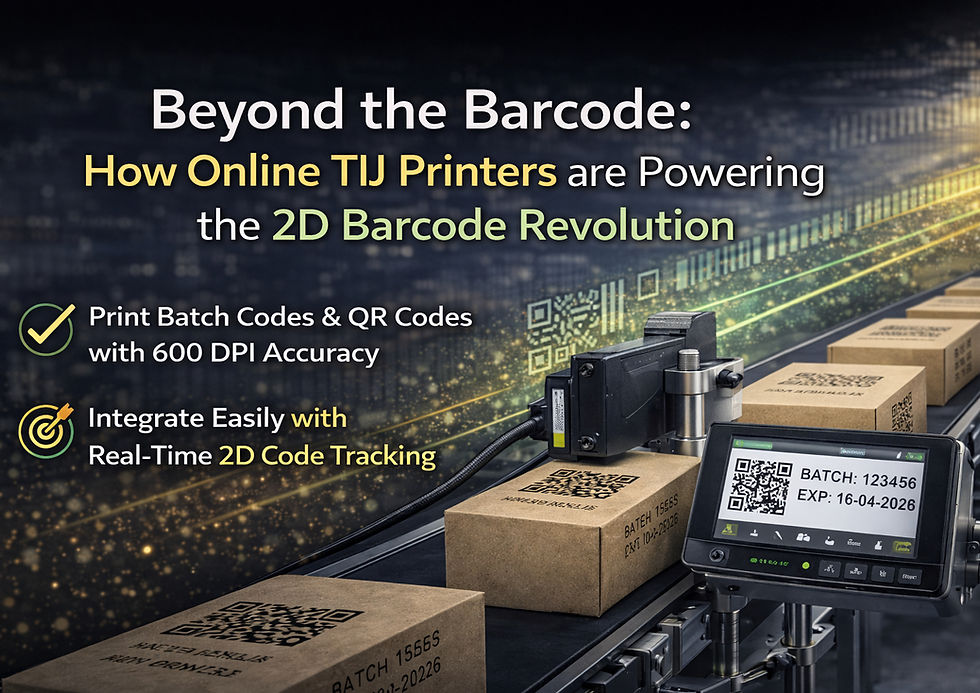
Barcode & QR Code Printing for Products in India: A Complete Guide for Brands
Introduction
If you want to sell your products through e-commerce platforms like Amazon and Flipkart, or supply to organised retail chains such as D-Mart, Reliance Retail, or Spencer’s, your products must have a barcode on the packaging.
Barcodes are the backbone of modern supply chain management. They help retailers track products, manage inventory, and ensure smooth checkout at stores.
For Indian manufacturers and FMCG brands, setting up a reliable barcode printing system has become a business necessity. Whether you are selling packaged foods, cosmetics, personal care products, or industrial goods, a scannable barcode on every product is essential for entering large distribution channels.
What Is a GS1 Barcode and Why Do You Need One?
GS1 is the global organisation responsible for standardised barcodes used in retail and e-commerce worldwide.
When you register with GS1 India, you receive a unique company prefix. Using this prefix, you generate GTINs (Global Trade Item Numbers) that uniquely identify each of your products.
Most modern trade retailers and online marketplaces require GS1-registered barcodes because they ensure that every product can be accurately tracked across supply chains.
Without a GS1 barcode, many retailers and marketplaces will not list your product.
Types of Barcodes Used on Packaged Products in India
Different types of barcodes are used depending on the product, packaging size, and industry requirements.
Common barcode formats include:
• EAN-13 - The most widely used barcode on retail consumer products worldwide
• EAN-8 - A compact version used when packaging space is limited
• QR Code - A two-dimensional code that can store URLs, product information, or authentication data
• DataMatrix - Commonly used in pharmaceutical and food traceability systems
• ITF-14 - Used on outer cartons and logistics packaging
Among these, EAN-13 is the standard barcode used on most retail products in India.
How to Print Barcodes on Product Packaging
Manufacturers typically use two main methods to print barcodes on packaging.
1. Pre-Printed Barcodes
In this method, the barcode is included directly in the packaging artwork and printed during the packaging film or label printing process.
This is the most common approach for product EAN barcodes that remain the same for every unit.
2. Variable Barcode Printing
In some cases, barcodes need to be printed dynamically during production.
Manufacturers use inkjet or TIJ printers to print barcodes directly on packaging, labels, or cartons as the product moves along the production line.
Many businesses use a combination of both approaches. The product barcode is pre-printed on the packaging design, while batch numbers, manufacturing dates, expiry dates, and QR codes are printed during packaging.
Barcode Printing Machines Used in India
Several types of barcode printing machines are used by manufacturers depending on packaging type and production speed.
Thermal Transfer Barcode Printers
These printers are commonly used to print barcode labels and stickers that are applied to products.
TIJ (Thermal Inkjet) Printers
TIJ printers are widely used for printing barcodes directly on packaging materials such as pouches, cartons, labels, and bottles.
They provide high-resolution printing and require minimal maintenance.
Continuous Inkjet Printers
These are used in high-speed manufacturing lines where continuous printing of variable information is required.
Online Coding Machines
These machines integrate directly with packaging machines to print barcodes, batch codes, expiry dates, and MRP information automatically during production.
Can a TIJ Printer Print Barcodes?
Yes. Modern TIJ printers can print high-quality barcodes and QR codes suitable for retail and logistics scanning.
Avant Garde Industries TIJ printers can print standard formats such as:
• EAN-13 barcodes
• QR codes
• DataMatrix codes
• Code 128 barcodes
With print resolutions ranging from 300 to 600 DPI, these printers produce sharp and scannable barcodes that meet retail scanning requirements.
Our online TIJ printing systems can also print multiple elements simultaneously, including barcode, batch number, MRP, and expiry date all from a single machine.
Why Barcode Verification Is Important
Printing a barcode is only part of the process. The barcode must also be easily scannable.
Poorly printed barcodes can cause problems such as:
• Checkout scanning failures in retail stores
• Delays in warehouse receiving
• Product rejection by retailers
To avoid these issues, manufacturers often use barcode scanners and verification systems to check barcode readability before products leave the factory.
This ensures that the printed barcode meets the scanning standards required by modern retail and logistics systems.
Conclusion
Barcodes have become a fundamental requirement for businesses that want to sell products through retail chains and e-commerce platforms.
Obtaining a GS1 barcode and setting up a reliable barcode printing system allows manufacturers to expand into larger markets and streamline their supply chain operations.
With the right barcode printing technology, businesses can ensure that every product leaving their facility is accurately identified, compliant with retail standards, and ready for distribution.
Avant Garde Industries offers complete barcode printing solutions, including TIJ printers designed to print high-quality barcodes and QR codes on a wide range of packaging surfaces.
Frequently Asked Questions (FAQs)
Do Amazon and Flipkart require GS1 barcodes?
Yes. Most e-commerce platforms require products to have GS1-registered barcodes to ensure accurate product identification.
Can QR codes be printed on product packaging?
Yes. QR codes can be printed on packaging to store additional information such as product details, website links, or authentication data.
What machine prints barcodes on pouches?
Manufacturers commonly use TIJ (Thermal Inkjet) printers to print barcodes directly on flexible packaging such as pouches.
Can a single machine print barcodes and expiry dates?
Yes. Modern coding machines can print barcodes, batch numbers, manufacturing dates, expiry dates, and pricing information simultaneously.