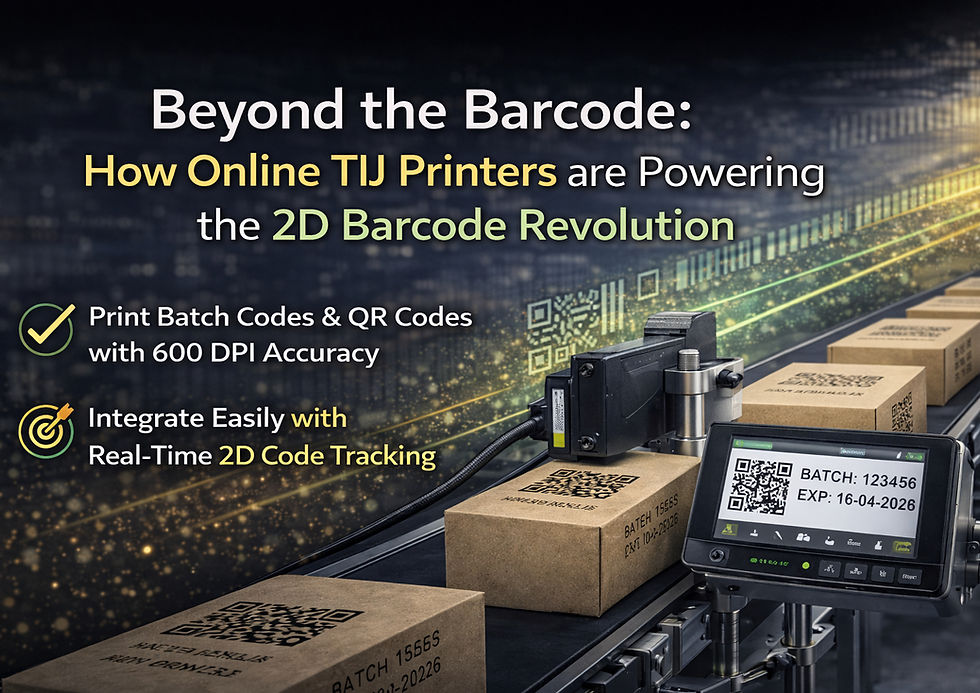
Inkjet-Printed Barcodes vs Labels: Which Is More Reliable on Production Lines?
Updated: May 4
Choosing the Right Barcode Application Method for Your Packaging Needs
Introduction
When it comes to applying barcodes on your product packaging, businesses typically choose between two methods:
Printing directly on the packaging using an inkjet (TIJ) printer
Applying a pre-printed barcode label
Both methods are widely used across industries in India. The right choice depends on your production setup, packaging type, and operational goals. Here’s a clear comparison to help you decide.
Pre-Printed Barcode Labels: Pros and Cons
Advantages
High and consistent print quality (printed in controlled environments)
Suitable for multi-color branding and complex designs
Wide range of label materials for different surfaces
Works well on uneven or difficult surfaces
Disadvantages
Requires an additional application step (manual or machine-based)
Needs label stock management - shortages can stop production
Risk of peeling, wrinkling, or misalignment
Higher per-unit consumable cost
Variable data printing requires additional setup
Direct Inkjet (TIJ) Barcode Printing: Pros and Cons
Advantages
Prints directly on the packaging with no extra step
No label inventory—only ink cartridges to manage
Supports real-time variable data (batch, date, serialization)
Lower operational cost per unit
Seamless integration into production lines
Disadvantages
Print quality depends on packaging surface compatibility
Requires correct ink selection for different materials
Limited compared to labels for high-end visual branding
Which Is More Reliable for Barcode Scanning?
Both methods can deliver excellent scan reliability when implemented correctly.
Pre-printed labels offer consistent print quality but may face issues like misalignment or adhesive failure during application.
Direct inkjet printing, especially with properly configured TIJ systems (300+ DPI with the right ink), can achieve 98-100% scan accuracy in real production environments.
In practice, reliability depends more on execution and setup than the method itself.
When Should You Choose Labels?
Labeling is a better choice when:
Your packaging requires premium branding or multi-color designs
You are working with irregular or textured surfaces
Product presentation and shelf appeal are a priority
You already have a labeling system in place
When Should You Choose Direct Inkjet Printing?
Direct printing is ideal when:
You want faster production with fewer steps
You need variable data printing (batch, MRP, QR, etc.)
You want to reduce operational and consumable costs
You are running a high-speed production line
Additional Considerations for Barcode Application
Understanding Your Production Environment
Before making a decision, consider your production environment. The speed of your production line and the type of products you are packaging can influence your choice. For example, if your production line is fast-paced, direct inkjet printing may be more suitable. It reduces the number of steps involved and can keep up with high-speed operations.
Cost Analysis
Cost is a critical factor in any business decision. Pre-printed labels may have a higher upfront cost due to the need for label stock and printing setup. In contrast, direct inkjet printing can lower your operational costs over time. It eliminates the need for label management and reduces waste.
Flexibility and Adaptability
Consider how often your packaging design changes. If you frequently update your product packaging, direct inkjet printing offers more flexibility. It allows for quick adjustments without the need for new labels. This adaptability can be a significant advantage in a competitive market.
Conclusion
There is no one-size-fits-all answer.
Labels are best for branding-heavy applications and complex surfaces.
Direct inkjet (TIJ) printing is ideal for efficiency, speed, and cost-effectiveness.
The right solution depends on your production line requirements, packaging material, and business priorities. At Avant Garde Industries, we offer both TIJ barcode printing systems and labeling solutions. We help you choose what works best for your application.
By understanding the pros and cons of each method, you can make an informed decision that enhances your packaging process. Whether you opt for labels or direct printing, the goal is to ensure your products are clearly marked and ready for the market.